
From Suffering to Secure
The Contemplative Path to Attachment Healing
An 8-week online course
From Suffering to Secure
A contemplative, science-informed path to attachment security through Ideal Parent practice and meditation. Heal your attachment patterns with gentle, evidence-based practices that build lasting security in body, mind, and relationships.
Begin the JourneyTHIS COURSE IS FOR YOU IF
- You’re familiar with basic attachment ideas and want something deeper and more accurate than pop‑psychology content.
- You’re drawn to contemplative practice (including but not limited to Buddhism) and sense that healing your attachment patterns is an integral part of your spiritual path to greater freedom.
- You often feel anxious, shut down, or confused in relationships and want practical, repeatable ways to work with these patterns.
- You’re curious about Ideal Parent Figure work and want guided support applying it safely and gently.
- You want both a clear conceptual framework and concrete practices you can come back to and continue to develop over time.
If you are looking for a powerful healing path of contemplative practice that offers concrete, lasting change in the ways that you think, feel and relate to others - I made this course for you!


WHAT YOU'LL GAIN
Knowledge and transformation
My intention is that these eight weeks give you a practical path to follow for tangible, lasting transformation — not just a framework for understanding yourself, but a felt sense of the well-being that is possible when attachment healing and contemplative practice work together.
UNDERSTAND: Attachment science beyond what you've already read. A grounded, nuanced understanding of how attachment patterns form and show up — in your thoughts, emotions, body, and relationships.
FEEL: A reliable sense of inner security. Not just an idea of security, but a felt sense you come back to — especially when old patterns get activated.
TRUST: That your patterns can change. Genuine confidence that anxious, avoidant, or disorganized patterns are not fixed traits — they're conditioned, and they can shift.
PRACTICE: Tools you'll keep using. Meditations, Ideal Parent Figure practices, daily-life micro-practices, and reflections you can deepen for years to come.
INTEGRATE: Discover how healing and contemplative practice deepen each other. A living understanding of how attachment repair and your contemplative path reinforce one another, from easing everyday suffering to realizing profound awakening.
This isn't a quick fix — it's a clear, structured path. Think of these eight weeks as building the foundations for a longer journey toward becoming more secure and more free.
WHAT'S INCLUDED
Everything you need for the journey
8 on-demand classes [Lifetime access] - Video, audio and written teaching, guided practices, and resources for further study — yours to return to at any time.
Weekly guided practices - A curated set of meditations and journaling prompts to support your practice between sessions.
Daily-life micro-practices - Simple, doable actions to integrate into everyday life — gently rewiring attachment patterns over time.
Async Q&A and discussion - A private course space to ask questions, share reflections, and connect with fellow students and teachers.
Optional: Small-group coaching cohort - Live Ideal Parent Figure coaching, personalized guidance, and a small group of fellow practitioners. Maximum 10 participants.
You don't need to do everything or do it perfectly. Go at a pace that feels manageable — even small, consistent engagement can begin to shift how your system experiences safety and connection.

THE ROADMAP
The journey is organized into eight sessions
Each class builds on the last — weaving together attachment science, meditation and daily life practices.

Class 1: Establishing a secure base
The path to inner safety
We begin with what's already here: moments of connection, goodness, and ease. You'll start to taste what security feels like and learn how to access an internal sense of benevolent presence, even in an insecure world.

Class 2: Understanding insecurity and attachment strategies
Recognizing adaptive patterns with compassion
You'll learn to understand insecure attachment strategies as adaptive and workable, and begin recognizing your own patterns with curiosity and self-compassion rather than judgment or shame.

Class 3: Ideal Parent Figures
Remapping our inner models of safety and care
We'll focus on Ideal Parent Figure practices as a way of building an internal secure base, remapping your inner models of safety, care, support, and reliability over time.

Class 4: Growing metacognition
Seeing the mind clearly
This class develops metacognitive awareness, so you can recognize your mental and emotional patterns as conditioned experiences rather than fixed identities, and relate to them with more clarity and kindness.

Class 5: Dismissing Avoidant mindstates
Restoring connection
We'll explore avoidant attachment patterns, how they protect you, and how to meet emotional distance with compassion while gently restoring connection to yourself and others.

Class 6: Anxious Preoccupied mindstates
Regulating from the inside out
Here we look at preoccupied or anxious attachment patterns and their nervous-system roots, practicing ways to soothe and regulate from the inside out rather than relying solely on external reassurance.

Class 7: Disorganized and unresolved mindstates
Remembering our wholeness
We turn toward more chaotic or fragmented attachment experiences with an emphasis on safety, protection, and unconditional caring presence — discovering that all parts of us are worthy of unconditional love and protection and reweaving our inner integration.

Class 8: Relational security in practice
Bringing it all into your relationships
Finally, we integrate the work into our relationships — exploring how to bring love, wisdom, and collaboration into your connections, and how to continue cultivating relational security over time.
About the Teacher
Why I made this course
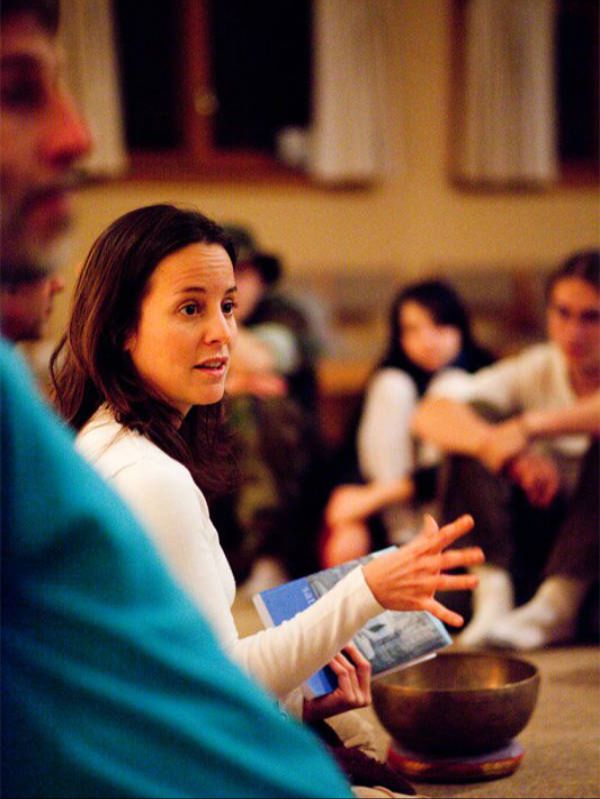
Jessica Morey
Meditation teacher · Contemplative coach · Course creator
My Story
I began meditating as a teenager. Serious practice, not casual — sitting long retreats at the Insight Meditation Society, traveling to Myanmar, ordaining as a Buddhist nun and practicing in a monastery. Throughout my twenties I dedicated most of my free time and vacations to silent retreats. I was, in the most sincere way, desperate to find what Buddhist practice promised: the end of suffering.
And I found real insight on the meditation cushion. Hours of deep joy and wellbeing during long silent retreats. Genuine peace and clarity. I could see my own mind with increasing precision — the arising of thoughts, the texture of emotions, the way reactivity moved through the body.
But consistently, when I'd return home and move back into daily life — into work, into relationships — so much suffering would come right back. I'd find myself shut down, irritated, anxious, isolating — sometimes seemingly all at once. Wracked with self-doubt, at times self-loathing that would slide into depression. I couldn't figure out how to build real intimacy or authentic connection, in friendships or romantic relationships. I kept a distance, not wanting people to discover how messed up I really felt inside.
The cruel paradox was this: all that practice meant I could see these patterns with painful clarity. I could watch myself pull away, criticize, sabotage. I could feel the suffering in real time. I just couldn't change it. I'd pick emotionally unavailable partners or find ways to undermine relationships with real potential.

Discovering Attachment Theory
Everything began to shift when I was introduced to Attachment Theory in 2010. For the first time, my feelings, thoughts and behaviors started to make sense — not as personal failings or spiritual inadequacy, but as maps. Maps drawn in early childhood, from experiences with my parents, who came by their own patterns honestly, as we all do. I wasn't a failure. I was working from an old blueprint.
My first foray into attachment healing — through specific meditation practices — helped me see much more clearly how I was creating my present-day relational reality based on those childhood maps. And I began to learn that I didn't have to follow those impulses automatically. I could pause. I could choose differently. Even if it took every ounce of self-awareness and willpower I had.
It was meaningful progress. But something was still missing.
Finding the Ideal Parent Protocol
Then I met Dr. Dan Brown — psychologist, Harvard professor, trauma expert, and Tibetan meditation master. During a weeklong retreat, he introduced his Ideal Parent Figure meditation and his landmark book Attachment Disturbances in Adults: Treatment for Comprehensive Repair.
Something in me knew immediately. This was the practice I had been missing — not just for understanding my patterns, but for actually changing them at the root.
I worked directly with Dan as both my therapist and meditation teacher for a number of years, and trained with him in the Ideal Parent Protocol until his death in 2022. What this practice offered was something my nervous system never fully received: the felt sense of being consistently seen, soothed, safe, and supported. Not as a concept but as a living, breathing inner experience that becomes more and more accessible over time.
Why These Two Paths Belong Together
I want to be honest about what meditation did and didn't do for me — because I think it matters for anyone who comes to this work with a serious practice background.
Meditation — especially mindfulness, Vipassana, and heart practices like loving-kindness and compassion — built an essential foundation. The capacity to witness my own experience without immediately being swept away by it. The ability to notice a pattern arising before I was already three steps into it. The willingness to sit with discomfort rather than numb out. These capacities are not peripheral to attachment healing — they are central to it. Self-awareness and self-regulation are the ground on which this work happens.
But awareness alone did not transform my relational patterns at the root. I could see the blueprint clearly. I couldn't rewrite it — not through cognitive insight alone.
That's what the Ideal Parent Protocol does. It works at the level where the original patterns were laid down — embodied, experiential, pre-verbal — and it does so in a way that meditation practice actually supports and deepens. The two paths are, I believe, most powerful in combination. Contemplative practice develops the inner witness and the capacity for presence and focus. Attachment repair work uses that focused presence to update the underlying patterns.
Together, they create the conditions for reliable, lasting well-being — in our minds, bodies and relationships.
What Changed
The external changes have been real and significant. I'm happily married — almost 15 years — to someone I kept trying to leave before this work. We have a toddler and a new baby on the way. Parenting has given me more opportunity than almost anything else to see and feel all that has transformed in my relational patterns.
But the changes that feel the most dramatic are the ones only I have witnessed.
I remember the first time I noticed something had fundamentally shifted. A work email arrived pointing out a mistake I'd made and the impact it had on someone. Before this practice, that kind of email would have devastated me for days — replaying it, judging myself, reinforcing the belief that I was irredeemably flawed, panicked that the world would eventually discover this and cast me out.
But this time, the first thought in my mind — like a warm, friendly voice — was simply: It's okay. People make mistakes.
I literally stopped in my tracks. Because that voice was new. It was a benevolent, loving presence — always there, I now understand, just so often covered over by years of conditioning. Warm. Steady. Oriented toward honest growth, from love rather than fear.
That presence has made all the difference. In conflict with my husband. In my parenting. In my work. In the quiet of my own mind on an ordinary afternoon.
It's why I do this work. And it's why I know you can find that same presence in yourself — because it was never something I created. It was something I uncovered.
Credentials:
Attachment & Psychological Training
- Client and Trainee, Ideal Parent Figure Protocol — Dr. Dan Brown
- Certified, Integrative Attachment Therapy Levels 1, 2 & 3 — Dr. David Elliott
- Certified, Internal Family Systems Level 1
- Certified, Somatic Experiencing Level 1
Contemplative Training & Teaching
- 30+ years of dedicated Buddhist meditation practice
- Retreat teacher, Insight Meditation Society & Spirit Rock
- 20 years of teaching, thousands of students
- Founder, Lead Teacher and Executive Director, Inward Bound Mindfulness Education
- Founder and Lead Faculty, Contemplative Semester

What people say
From those who have done this work with me
"Jess embodies the compassion, curiosity, and encouragement of the ideal parent practices she teaches, while also offering keen insights and gently challenging me.
As a result of our work together, I have gained confidence in myself and my ability to navigate relationships, and I experience less self-judgment and shame in relational contexts.
Her guidance has helped me to not only know myself better but also to treat myself with much more self-compassion."
– RF, 1:1 Attachment Client

"The ideal parent work has had a profound impact on me. It feels like a fundamental paradigm shift… it has had a huge impact on how I'm interacting with my family, students, colleagues, etc.
The ideal parent experiences have given me a much deeper well to draw from."
– Matt, 1:1 Attachment Client
"Jess helped me bridge a gap I had long struggled to name — the distance between outward professional success and a quiet, persistent sense of incompleteness — through a skillful blend of ideal parent work and contemplative meditation practice.
Her approach created the space to honestly explore questions of attachment and identity, ultimately leading me to a more genuine understanding of my own true nature and what it truly means to be enough."
– Jim, 1:1 Attachment Client

ENROLLMENT & PRICING
Ready to begin?
Eight weeks of structured teaching, guided practice, and community support — with tools you'll return to long after the course ends.
The Contemplative Path to Attachment Security
From Suffering to Secure
$350
or 3 monthly payments of $120
JOIN THE COURSE
Optional Small‑Group Coaching Cohort
Live coaching and personalized support
$720
or 2 payments of $375 — core course required
JOIN THE WAITLISTScholarships and financial accessibility
APPLY FOR SCHOLARSHIPFrequently Asked Questions
If something isn't covered here, you're welcome to reach out directly.
What if I'm new to attachment theory or meditation?
I've already read about attachment — will this go deeper?
How does this differ from books or podcasts on attachment?
Is this connected to a particular spiritual tradition?
Will this replace therapy?
What about safety, triggers, and pacing?
How much time should I plan for each week?
What if the course isn't a good fit?
Still have questions? Feel free to reach out.
JOIN THE COURSEGet in touch
Have a question or want to share something? I’d love to hear from you.